
As of February 2026, 75% of executives report significant hurdles in their digital transformation journeys, and the single biggest root cause isn’t budget or talent. It’s the absence of systematic, research-driven decision-making (McKinsey Global Survey, 2025). In an era defined by rapid technological shifts, post-pandemic market realignments, and AI disruption arriving faster than most strategic plans anticipated, flying by instinct has become an expensive habit.
Businesses that fail to anchor their strategies in rigorous market intelligence are discovering this the hard way: missed pivots, misallocated budgets, and ceding market share to leaner, data-informed competitors. The economic turbulence of 2025: supply chain normalization, interest rate volatility, and accelerating AI commoditization, has rewritten the rules for what it takes to scale.
The thesis is simple: research-driven business strategy is no longer a luxury or a competitive advantage, it is the baseline for survival and the accelerant for scale. At Yventure Strategy, our clients who adopt structured research frameworks consistently achieve 20%+ efficiency gains within the first two quarters of implementation. This post breaks down the trends driving this shift, the frameworks that deliver results, and the exact steps you can take to build a research-first culture, beginning this week.
The Rise of Research-Driven Strategy in 2026 Business Trends
The business research landscape has undergone a quiet revolution. What was once the domain of large enterprises with dedicated market intelligence teams is now accessible, and expected, at every stage of growth. Three macro-trends are driving this shift in 2026.
Trend 1: Data-Backed Decisions Are Compounding Returns
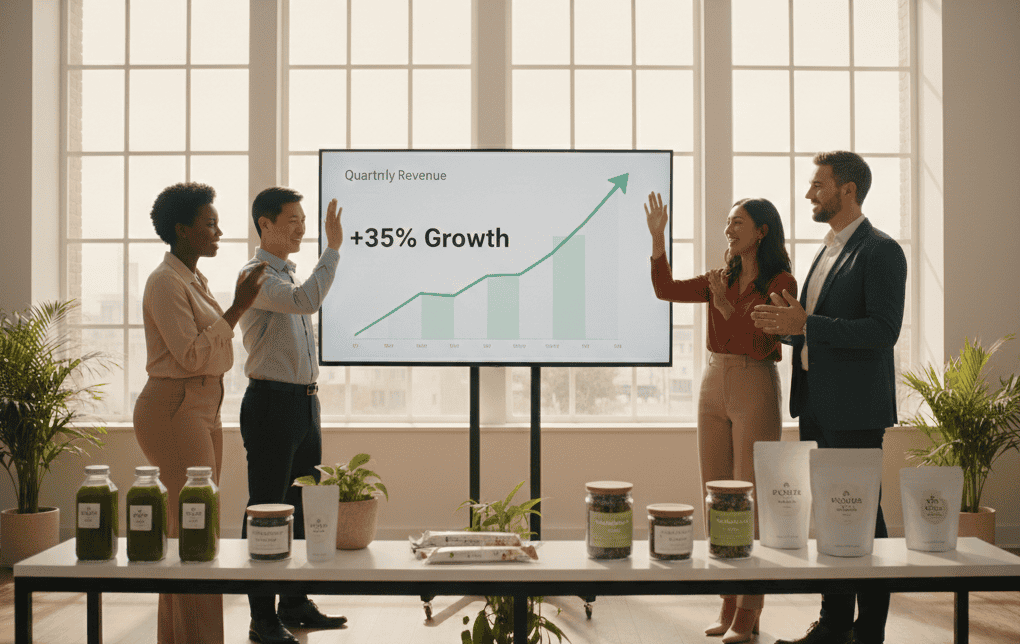
Organizations that leverage customer behavioral data in their core strategies are 23 times more likely to acquire customers, 6 times more likely to retain them, and 19 times more likely to be profitable than competitors who don’t (McKinsey Analytics, 2025). As AI tools have reduced the cost of data collection and analysis by an estimated 40% since 2023 (Gartner, 2025), the excuses for gut-feel strategy have evaporated.
Trend 2: Sustainability and AI Research Are Now Table Stakes for Resilience
Investor and consumer expectations have converged. A 2025 Gartner survey found that 68% of B2B buyers now conduct ESG due diligence before finalizing vendor contracts — up from 41% in 2022. Simultaneously, companies integrating AI-powered competitive intelligence into their research stack are identifying market shifts an average of 4.2 months earlier than those relying on traditional quarterly reviews (Forrester Research, 2025). Research is no longer about understanding where the market is — it’s about anticipating where it’s going.
YVenture Insight: Across our client portfolio, companies that institutionalize quarterly research cycles — combining primary consumer interviews, secondary market data, and AI-driven signal monitoring — report an average 5–10% revenue uplift within six months, with compounding returns as the research function matures.
Top 2026 Research Priorities for Growth-Stage Companies
- Competitive market analysis: Mapping competitor positioning, pricing signals, and whitespace opportunities using AI-assisted monitoring tools.
- Consumer behavior and sentiment shifts: Ongoing qualitative and quantitative research to track evolving buyer psychology in a post-AI-proliferation market.
- Macroeconomic scenario modeling: Building contingency strategies for 2–3 plausible economic scenarios, not just the base case.
- Technology adoption curves: Benchmarking where your sector sits on the AI adoption S-curve to identify first-mover opportunities.
- Regulatory and sustainability intelligence: Monitoring policy shifts and ESG benchmarks before they become compliance requirements.
Related reading: Competitive Intelligence Frameworks for 2026 | 2026 Food & Wellness Growth: 5 Strategies to Outpace Competitors
Key Frameworks for Research-Driven Growth
Understanding that research matters is one thing. Operationalizing it inside a fast-moving business is another. At Yventure, we’ve codified two flagship frameworks that consistently turn raw market intelligence into executable strategy — regardless of company size or sector.
Framework 1: Buyer Journey Research Mapping (Awareness → Consideration → Decision)
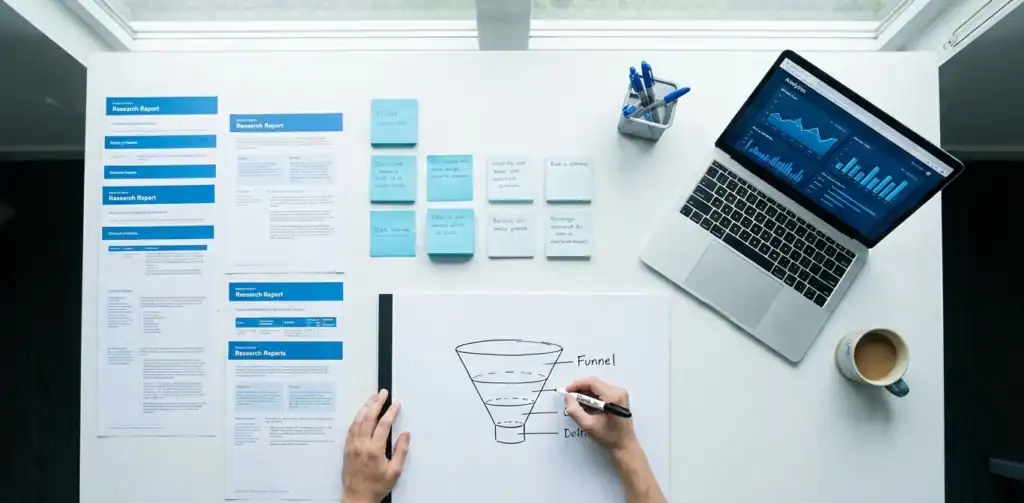
Most B2B companies understand their sales funnel. Far fewer understand the research triggers that move a prospect through it. YVenture’s Buyer Journey Research Mapping framework layers three types of intelligence onto your existing funnel:
- Awareness Stage: Category-level search trend analysis (using tools like Google Trends, SEMrush, and SparkToro) to understand what problems your ideal customers are actively researching — before they know your product exists.
- Consideration Stage: Win/loss interview programs and competitor content gap analysis to understand why prospects evaluate alternatives and what objections surface most frequently.
- Decision Stage: Quantitative survey data on the top 3–5 criteria buyers weight most heavily in final vendor selection — refreshed at minimum semi-annually, as priorities shift with market conditions.
The output is a living document — not a static slide deck — that informs messaging, product roadmap prioritization, and sales enablement simultaneously.
Framework 2: AI-Powered Scenario Planning for Startups and Scale-Ups
Traditional scenario planning required weeks of analyst hours. AI has compressed that to days. YVenture’s AI-Powered Scenario Planning framework uses large language models combined with live market data feeds to generate and stress-test three strategic scenarios in parallel: a base case, an upside case, and a downside case — each with pre-defined trigger metrics that signal which scenario is materializing in real time.
This is particularly powerful for startup market research, where resource constraints make it critical to place strategic bets early and adjust quickly. Companies using this framework have reduced their strategic pivot lag, the time between a market signal and an operational response, from an industry average of 4.7 months to under 6 weeks.
Gut Feel vs. Research-Driven: A Direct Comparison
| Approach | Strategic Success Rate | Typical Outcome | Time to Insight |
|---|---|---|---|
| Gut Feel / Intuition-Led | -+40% | Missed market pivot; product-market fit lag; reactive spending | Weeks–months (post-failure analysis) |
| Research-Driven Strategy | -+85% | 20% revenue growth; early competitor identification; capital efficiency | Days–weeks (predictive signals) |
Success rate benchmarks derived from McKinsey’s Strategy & Corporate Finance practice research, 2024–2025.
How Yventure Implements Research-Driven Strategy: 3 Steps
- Research Audit & Gap Analysis (Week 1–2): We begin every engagement with a structured audit of what data the client already has, what decisions are being made without adequate data, and what competitive blind spots exist. The output is a prioritized “research debt” backlog — organized by business impact, not technical complexity.
- Research Stack Build & Activation (Week 3–6): We configure a right-sized tool stack — typically combining one primary analytics platform (e.g., Google Analytics 4 + Mixpanel), one competitive intelligence tool (e.g., Similarweb, Crayon), and one AI synthesis layer. Critically, we connect these tools to existing reporting cadences so research becomes ambient, not episodic.
- Research Rhythm Institutionalization (Month 2–3): Sustainable growth research requires cadence. We establish weekly signal reviews (30 minutes, focused on anomalies), monthly competitive snapshots, and quarterly strategic recalibrations. Each session has a template, an owner, and a decision log — so insights translate directly into action, not just awareness.
Actionable Steps to Build Your Research Strategy Today
Knowing you need a research-driven strategy and building one are different challenges. Here is a practical, sequence-tested roadmap any growth-stage company can execute, regardless of current research maturity.
- Audit your current data gaps. Map what decisions your leadership team made in the last 90 days and identify which lacked adequate research backing. This audit typically takes 2–3 hours and immediately reveals your highest-leverage research investments.
- Build a right-sized tool stack. For most growth-stage companies, a three-layer stack is sufficient: (1) a behavioral analytics layer (GA4, Mixpanel, or Amplitude), (2) a competitive intelligence layer (Similarweb, SparkToro, or Crayon), and (3) an AI synthesis layer to surface patterns from unstructured data. Resist the urge to over-invest before your research rhythm is established.
- Partner with experts who specialize in growth consulting research frameworks. Internal teams often lack the objective distance and pattern recognition that comes from working across dozens of industries. YVenture’s engagements build your internal capability while delivering immediate insights — so the investment compounds, not creates dependency.
Your 30/60/90-Day Quick-Win Timeline
| Timeframe | Phase | Focus |
|---|---|---|
| Days 1–30 | Foundation Sprint | Complete research audit. Identify top 3 unanswered strategic questions. Install analytics stack. Schedule first win/loss interviews. |
| Days 31–60 | Signal Activation | Launch competitive monitoring cadence. Complete buyer journey mapping for primary ICP. Deliver first research brief to leadership. |
| Days 61–90 | Strategy Integration | Run first AI-powered scenario planning session. Connect research outputs to Q3 planning. Measure early impact on pipeline quality. |
Quick Win: The fastest research ROI in our client experience? Win/loss interviews. A structured program of 8–12 interviews with recent won and lost opportunities typically delivers actionable insights within 3 weeks — and pays for itself in the first sales cycle improvement.
Conclusion: Research Is Your 2026 Competitive Edge
The businesses that will define their categories in 2026 are not necessarily the ones with the biggest budgets or the most aggressive sales teams. They are the ones that understand their markets more deeply, anticipate shifts more accurately, and make faster, better-calibrated decisions than their competitors. Research-driven strategy is the system that makes all of that possible.
The frameworks exist. The tools are accessible. The case studies are proven. What separates companies that embrace research-driven growth from those that continue to rely on intuition is a decision, and the right partner to help execute it.
Ready to Build Your Research-Driven Growth Strategy?
Book a free strategy audit with the YVenture team. In 45 minutes, we’ll identify your top 3 research gaps and outline a custom framework for your business.
Ready to Lead Your Category in 2026?